Cancer 72
Posted on August 22, 2023 1 Comment
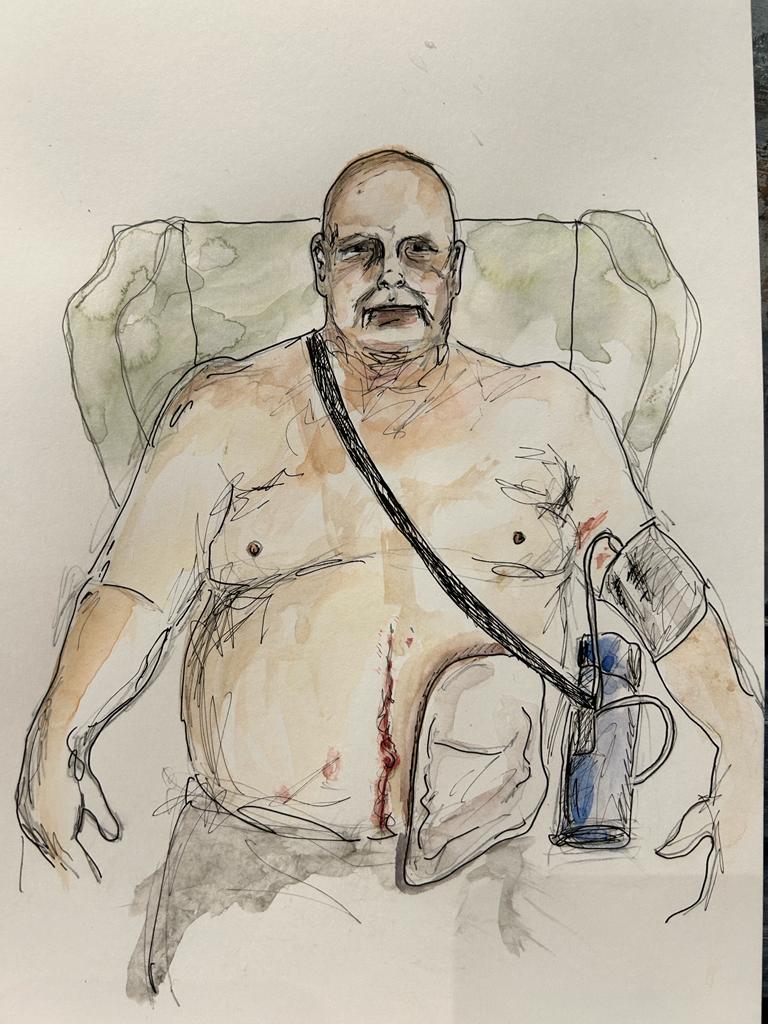
I am sitting in the cancer ward with my drugs drip dripping into my arm for the 6th time. This is the last round of my first cycle. All being well I will start the next cycle immediately. This is the 11th week of my chemo. If I complete two full cycles I will have been undergoing treatment for 24 weeks, nearly half a year. At this very moment, and I know I have written about this very moment before, I am feeling somewhat lightheaded, my guts are churning and I am having some abdominal pain. Don’t tell anyone though, it is best if they don’t know.
I have had the lightheadedness before. It probably arises from taking both drugs at once at the fastest possible rate. If I took them at the slowest rate it would take around 5 hours plus changeovers, flushes, etc. At the fastest rate with both drugs it takes two hours, so I suppose it is my fault. The churning guts are probably related. It is probably because I am in general eating too much. I was weighed today and it has increased by 2kg since my last treatment. I need to follow that particularly effective diet called eat less, especially less cake – which is difficult when my other great pleasure, alcohol, has disappeared from my life for the last three and a half years. I need either alcohol or chocolate cake because I am certainly not going to take up smoking.
That leaves the abdominal pains, which have increased over the last few weeks. What these are is difficult to say, but perhaps bowel cancer is a clue. There are a number of possibilities. First, I am neurotic and imagining these pains. That is quite possible. Second, tumours are growing. That too is quite possible. I am stage three with fast growing tumours, though they were not fast growing between my operation and starting chemo. Third, the chemo drugs are eating away at the bits I don’t want them to eat away, eg my abdominal wall, liver, stomach, etc. That is also quite possible and may be an indicator that at some point I should stop treatment and let things repaid (though that is the point at which tumours may grow. Decisions, decisions). Fourth, and I would like this to be the reality, my abdomen has been battered and punctured over the last few months. Now I have started moving more, gardening, etc (I threw my old lawnmower into a high skip at the tip the other day. It really flew above my head height – hello the return of strength), my abdomen is protesting and saying that it is somewhat weakened by recent experience and I should be more careful.
I choose the last option.
Cancer 71
Posted on August 19, 2023 Leave a Comment
The cancer nurse I spoke to yesterday said I was boring. I am not used to being called boring. I am called many names that are not particularly pleasant but boring isn’t usually one of them. On this occasion though I was glad to be called boring, as he was referring to my most recent blood test results. Everything is where it should be. As I am getting ready for my 6th round of chemo my body is as normal as it can be. I have abdominal pains, I have some side effects from the chemo – well, a little diarrhoea and a lot of tiredness, nothing too bad – but generally, I am feeling reasonably fit and well. I was told the other day, as we walked up to the Lodore Falls in the Lake District that I had a spring in my step, perhaps for the first time in many months.
I am working on my novel. I wrote 5,000 words yesterday so my head hurts. I dealt with the training of the Parliamentary Army through to the Battle of Edghill. I won’t write anything today. I am enjoying trying to write something different to the usual academic stuff. Re my Applied Narrative Psychology book, I have a draft of the cover, and I am working through the proofs, so all is well for the January release. I am still wanting to complete any academic articles outstanding, so those of you who have such materials get in touch and let’s get things written. You know who you are.
We have had another few days in Northumbria, my latest favourite county, exploring the Roman remains and eating well. We also spent a night at a very nice spa hotel in the Lake District. I got told off by the nurses for going to a spa with a PICC line in and while undergoing chemo as my immune system is probably shot to pieces, but there you go.
My favourite hobby is driving, and re my cancer, one of the biggest worries is that I may get so unwell I cannot drive. That would be awful. I love driving around the country, and around other countries, but that is off the agenda while I am undergoing treatment. Also, I have not yet received my government paid for car. In case anybody is concerned that I am getting a government paid for car, then remember I am unlikely to get any of the state pension I have paid into for the whole of my adult life so I need to get whatever benefits I can while I am still here.
After the 6th round of chemo I will be having a CT scan to see what is happening in my abdomen. Hopefully it will show that no new tumours have grown, but who knows. If all is well then the chemo will continue for another 6 rounds, another 12 weeks. I am utterly sick of it. I don’t like being in the hospital for one day every fortnight. I don’t like having a bottle attached for the next two days. I suppose it could be worse.
Cancer 70
Posted on August 8, 2023 Leave a Comment
I am in treatment again. Number 5 out of 6. I have got them to pump the muck into me as quickly as possible so I can get away from the hospital as quickly as possible. The novelty has worn off. The two week cycle is getting tedious. These three days of treatment, instead of providing an ideal opportunity to sit and write, is just something I want to get over asap. I still have my 6 day reward to look forward to. On Friday we head to Northumberland again, our latest favourite place. If you don’t know Northumberland then you should. If I was entirely neutral about my favourite and least favourite counties, which I am not, then Northumberland would be my favourite county. It has great castles and houses, hills, Roman bits and pieces, lovely food and people, and not least, the lowest number of people per square mile in England. What is not to like?
I wonder whether I will have another 6 fortnightly treatments immediately after this one, whether I will have a break from treatment, be moved onto another treatment, or be seen as a dead end case where there is no point in further treatment. The way my abdomen feels most of the time I am not always able to generate my external positive optimistic self, though of course it could just be the effect of the drugs. I still haven’t lost my appetite. My weight is still increasing. Good or bad? No idea.
The hospital is so noisy. The beeps of the machines, the television in the waiting room, the radio in the treatment room (it is on one of those ghastly commercial stations which have adverts – shocking. Haven’t they heard of the BBC?), people who think watching videos on their phones with the sound on is somehow acceptable. Then there are the tattoos – so visual they are auditory.
I am still trying to write. I am enjoying studying my novel writing course and have just sent off the work for the 4th module. I am going through them at the rate of one a week – not bad considering I wanted to achieve one a month. I have also written 9,000 words of my novel about the Civil War. It might be the second draft of something I wrote 100,000 words on about 20 years ago but this is a total rewrite, this time I am trying to write in the 1st person. I write quickly but not often enough.
I have got the proofs through for my Applied Narrative Psychology book. That will be fun to go through, so I had better get on with it from tomorrow as I sit there with my damned bottle attached.
It is better than working – isn’t it?
See, the optimism – or the delusional thinking – still applies….
Cancer 69
Posted on August 2, 2023 Leave a Comment
It is 4am. Like most nights, I have been up for hours. Usually I just sit and read. I sometimes write, but it is often too much effort. Tonight I decided to watch a film. I watched Dunkirk, the 2017 version rather than the John Mills version from the 1960s. I have watched it once before. I thought it was dire then, I now think it is one of the worst war films I have ever seen.
For some reason Dunkirk gets good reviews. Some see it as one of the best war films ever. I really do not understand why. Fromm the very start it is apalling. There is enemy gunfire so a group of soldiers run up the middle of the road, throwing their rifles away. I know some soldiers threw their rifles away, but professional soldiers running up the midde of the road with no cover?
From there it just gets worse. None of it makes any sense. The limited dialogue is cliched. The mole is either empty or full of soldiers depending on whether Kenneth Brannagh is on it. A spitfire pilot carries on fighting and runs out of fuel rather than returns home. A small boat just sets off on its own rather than waiting for RN crew. The same boat returns to Dorset with a load of soldiers. Dorset? Is that across from Dunkirk? It didn’t happen, it wouldn’t happen. Apparently hundreds of other soldiers were also brought back to the same place, then entrained to Woking where Churchill has somehow already made his ‘beaches’ speech and it is printed in the newspaper. OK, that one might be possibl as it was made on 4th June, but we then hear Kenneth Brnnagh is staying behind to help the French, so the timing doesn’t work.
How does a fishing boat suddenly fill up with water from a few bullet holes? And why don’t the soldiers aboard, instead of panicking, just climb up the bleedingly obvious ladder and escape? Why are the beaches virtually empty of troops? Where is all the abandoned equipment? Why are the lights on in Dunkirk (no they are not all fires)? Why do the planes never get to Dunkirk? Why are the seas empty of ships? Why is one ship anchored seemingly miles out to sea? How can a Spitfire that is out of fuel glide apparently overnight, never leaving the beaches, and apparenty shooting down an enemy plane? There is a lot of disjointedness regarding time. It is daylight in France, night in the UK, etc. Also, token woman nurse in destroyer. Really?
I could go on but my point is made. Yes, there is artistic licence, but how can one writer/director, who should have continued with his silly Batman films, get so much so wrong and yet have audiences who somehow think it is acceptable to produce such utter nonsense?
I have read about Dunkirk, I have met and interviewed Dunkirk veterans. I wasn’t there. None of us know what it was really like, but we can be fairly sure that this awful film does not represent anything of the reality.
As for my cancer, I am four rounds in, still eating too much, having a couple of days in Shrewsbury (nice town), and still getting very tired.
 Dr Nigel Hunt