Cancer 24
Posted on March 15, 2023 2 Comments
Yesterday was my sister’s funeral. She was 63 and died of cancer. The funeral was at Markeaton Crematorium and I was allowed out of hospital for the ceremony.
There had been massive organising behind the scenes (behind my scenes anyway) between members of the family, NHS staff and funeral organisers to put in place the possibility of me watching a live stream of the funeral. Everybody was so kind and helpful. Fortunately I could attend.
Sue, Jack and Sarah picked me up from the hospital and drove me to the crematorium. The service was – and this is where no words represent the truth – good, with Sally at the helm. She has now done the funerals of three members of my childhood nuclear family. I told her I would be next.
I did not like being the cripple at the event. People were nice to me, shared a few words and so on, but it was from within me. I was seething at the situation. Helen dying, then I will die. It is not about injustice. It just is, but I would rather it was something else. It confused the situation, the service. Here I was, to grieve for my sister, but I couldn’t, because I was too caught up in myself, the pain, the lack of control. The lack of future.
I managed to reflect on our shared childhood, but at the time it was more like parallel play. We rarely played together, partly because of the age gap, partly because we we the opposite sex, but we spent a lot of time together in the car, in the evenings, often bickering.
In the ceremony it was suggested that she had a stricter upbringing than me. I don’t think that was the case. Girls and boys did get treated differently, particularly when teenagers. My Dad picked Helen up from the pub. He never picked me up, but that was a sense of chivalry rather than getting her home on time. I had to walk several miles in all weathers.
It was the most – and here I am at a loss for words – stimulating, important, central – funeral I have attended. She was my sister. Whether we got on or not is irrelevent. She was the closest person to me. We came out of the same womb, shared genes, shared a childhood that was to the exclusion of everyone else at the funeral. I knew her as a small child. It is odd that she is dead.
Cancer 23
Posted on March 14, 2023 Leave a Comment
Sleepless nights on uncomfortable hospital beds (too narrow, too short) does mean that I potentially have a lot of time for thinking. On the other hand the pain, the tiredness, the beeping of monitors, the noise of other patients and the movements of nurses are less conducive to thinking.
One thought that pops up, perhaps because it ia a cultural norm, is that of fear of death. We think that the dying fear death; many people say they fear death, so do I fear death? The simple answer is that it is the wrong question. I have no reason to fear death. There is no bearded fairy or fork-tongued demon waiting to determine whether I should spend eternity in the clouds or in a pit of fire. That is just daft, and is partly why I have no respect for religion or religious practice.
Mark Twain made a good point: ‘I do not fear death. I had been dead for billions and billions years before I was born and had not suffered the slightest inconvenience from it.’
A religious person might argue this is flawed as we may begin to exist at the point of birth (or conception) and then continue for eternity, but really? What is the logic behind a soul not existing before birth (or conception) and then continuing after death? It is death! End. Completion. Finshed. Done with. Over. Kaput. Muerte.
I think the real question, for me at least, is not around death itself but missing out. Of course once I am dead I am not missing anything, but now, before I am dead I can and do think about what I will miss out on, such as having more happily married years, especially post-retirement, just doing things together. It doesn’t matter what we do, it is missing out on being together. Perhaps I am greedy as I have had nearly 30 very happily married years. I am also missing out on children growing up. Some I have met, but some have not yet been born.
I am missing out on the books I wanted to write, particularly novels. I will never know whether I can write a good one. I probably won’t even see my current book, Applied Narrative Psychology, come out, though it is almost finished. I should get on with it instead of scribbling blogs!
These are just a few of the personal things I will miss. There are more, but in a more general sense will I see another winter? Will I see snow? Will I ever go abroad again? I certainly won’t see the UK take its rightful place in the EU. But these things don’t matter (apart perhaps from rejoining the EU) neither do any of those ‘places to see before you die’ ideas. I don’t understand them. I’ve seen places. I’ve not seen others. So what?
If I ask myself the question, what do I want to do if I get another 6 healthy months, I don’t know the answer. I suppose it is a sign that I am happy that I don’t really want to do anything different to what I have already been doing. Yes it would be nice to do certain things but if they don’t happen then I don’t really care.
Presumably this is the good life – but that can be a question for another day.
Cancer 22
Posted on March 13, 2023 Leave a Comment
I was looking at the Dignitas website earlier, wondering why it is only in Switzerland that there is a civilised way of dealing with voluntary death due to illness or disability. I wonder whether I should join, if only to be prepared for contingencies. As it says on the website, many people join to be reassured and never make use of its services, just happy in the knowledge of its availability. At least it then becomes an option. Given the amount of pain I am in when the drugs wear off, and the limited possibilities for the future, Dignitas may become one of the real options.
This may be cowardice, and just speaking from the perspective of it being early in the morning without drugs, but I don’t think so. Throughout this process I have tried to consider all the possibilities at the time, those opening up, those closing down. At the start I had positive options, the complete cure, the freedom from cancer. That option has gone. Now it is the options with cancer, which include palliative management and a relatively long life (not probable), palliative management and a few months (maybe), palliative management and weeks (perhaps a high probability given that I am receiving no chemo and the last tumour grew at such a fast rate).
As I have said before, I think I am ready for any of these options – particuarly if they can be managed without pain. The Dignitas option is for when this cannot happen. When I have had enough.
The problem is I don’t think those around me are ready. Why should they be? They are the ones who are going to survive this and live without me. It may be selfish of me but I think I will be missed. On the other hand who was it who said the dead are soon forgotten, to be recalled occasionally and with sadness, but the living get on with their lives?
I am the dead. I am not jealous of the living, because while they will live I won’t exist, so jealousy makes no sense. I would of course like to live, and I will take options that give me a better chance to survive a little longer, as long as it is a good life. I don’t want to sit in this hospital for the rest of my life, recovering from some operation, unable to breathe fresh air, unable to see my house and my loved ones, constantly requiring drugs for pain, and watching the faiing lives of the people in the beds around me.
I am the dead. Most people do not have the grim reaper holding his scythe above their heads. They do not know when they are to die, whether tomorrow or in decades. It makes a difference being dead. It is not that everything becomes focused, and seen sharply in the light of mortality. My body is spending too much time trying to mend the wound I have in my abdomen. It closes me in, focuses me on my own body to the exclusion of other matters. I am not watching the news. I don’t know what the weather is like. I am not even reading a novel. The only outside influences I have now are people, both visitors and those who send me messages.
I have little hope. I am not even really dreaming of getting home, driving somewhere nice, having a holiday, and so on. My biggest hope is to get home to my family and friends.
Cancer 21
Posted on March 12, 2023 Leave a Comment
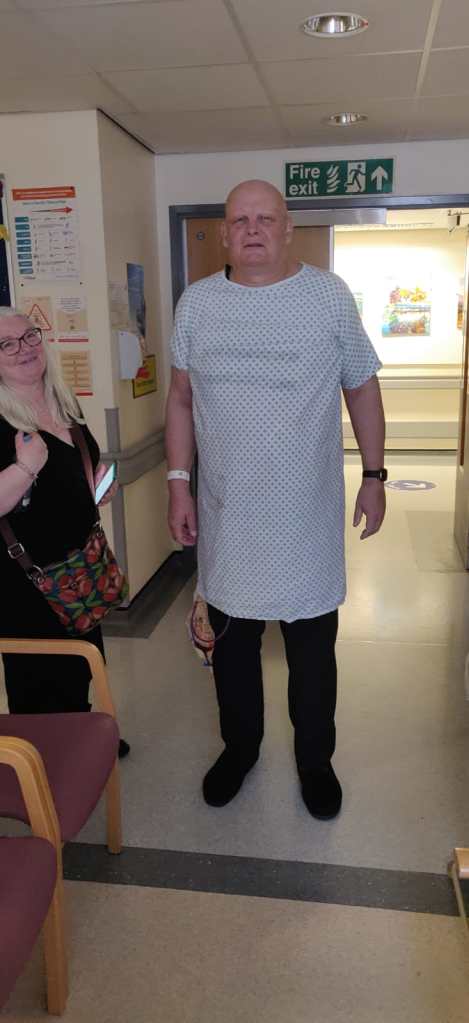
I have noticed that my blogs are not upbeat enough, though I keep saying they will be. Well, today I walked right round the ward and found the important places, the.kitchen and the storeroom. I actually wanted to walk further but I don’t think they will let me out of the ward just yet.
I am starting, at times, to feel some of my energy coming back; my desire to be up and at ’em. I might even be able to take my trousers off shortly. My stoma still isn’t working, apart from farting. Perhaps it is like a geyser, bubbling up for a while before it fully explodes. I want it to explode, then I can start eating properly. All I had today was two partial bowls of chicken soup and a couple of biscuits. I might treat myself to two more biscuits later when I drink my apple juice. I have not had any tea, which is unheard of.
I have just been listening to the nurse handover of me. The word ‘imdependence’ was used, along with ‘stable when walking’. There was talk of possibly getting day release for Tuesday!
One thing that still hurts is going for a wazz. The last time wasn’t as bad so perhaps by morning it will normalise.
I do genuinely feel a bit better. I am lying in bed but thinking I could spring upright. I couldn’t of course because my stomach muscles have been sliced through like an axe wound in a medieval battle as Jack and I discussed today. It isn’t of course. I was unconscious when I was wounded and have had lots of drugs to remove the pain. Medieval soldiers did not have these benefits, dying in agony instead.
Cancer 20
Posted on March 12, 2023 Leave a Comment
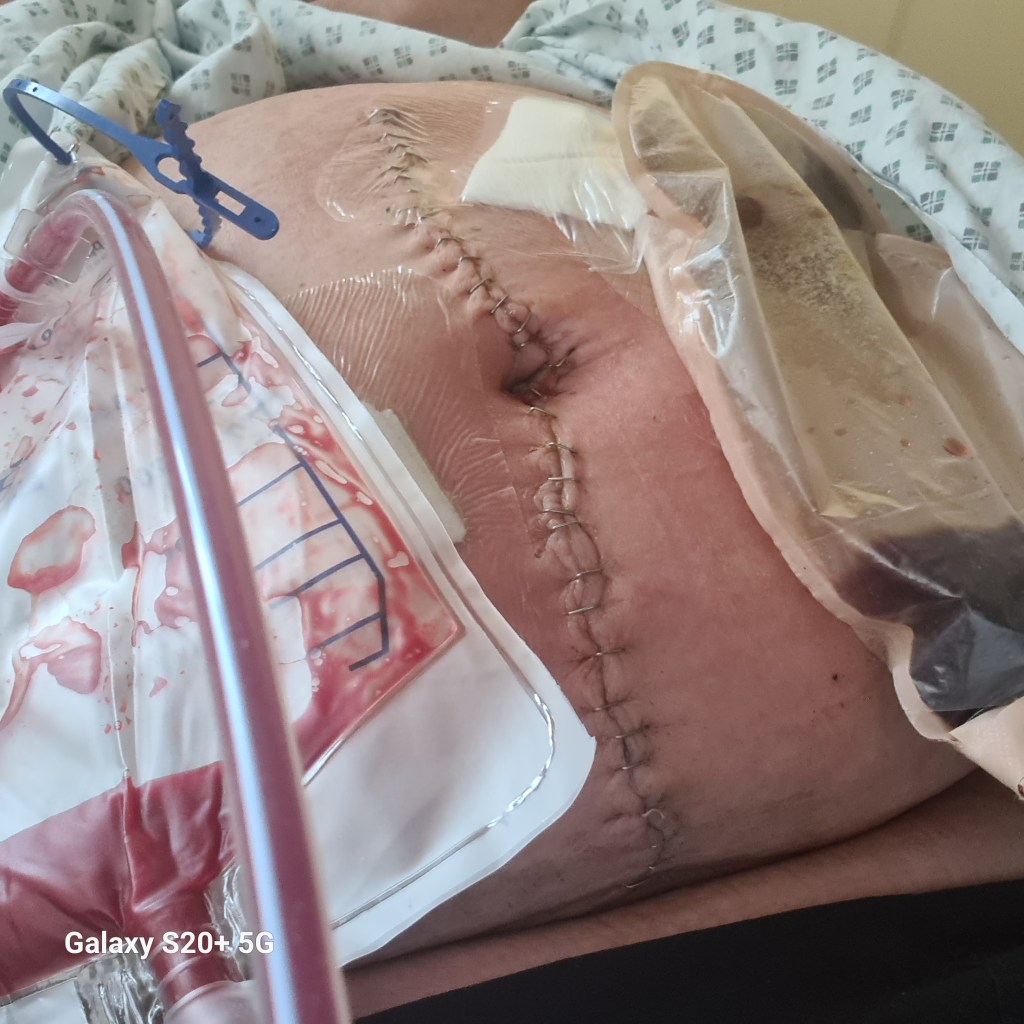
The dressing is removed. Let the air get to it. Just a few blisters, otherwise ok. The worst bit for me is that they cut through my belly button!
 Dr Nigel Hunt