Wingfield Manor
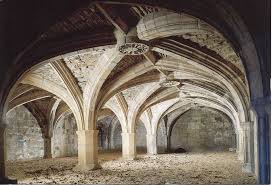
Wingfield Manor is one of the greatest unknown manor houses in England. It was built in the middle of the 15th Century and now lies ruined at the top of a hill in South Wingfield, Derbyshire. It was the model for the later (and larger) Hampton Court Palace. It is built of local stone, and retains numerous interesting architectural features, such as the Great Hall, the kitchens, and the tower which used to contain an early flushing toilet (basically people sat on pieces of overhanginging wood and did their business. A cistern at the top of the tower would flood the area and everything would wash into the old Norman moat).
The manor was built on the remains of a Norman castle, about which we know very little. Part of the moat remains around the outer walls.
The manor is linked with several characters and stories of national interest. It was built for Ralph Lord Cromwell who as a young man had fought at Agincourt with Henry V. He played an important role under Henry VI as treasurer, Privy Councillor and Chamberlain of the household, doing very well for himself financially out of these activities. He died in 1456 and the manor was bought by John Talbot, 2nd Earl of Shrewsbury, whose father had recently died commanding the english troops who died losing the Battle of Castilion, the final battle of the 100 Years War, which saw the French victorious.
The manor stayed in the same family for some time. In the 1580s Mary Queen of Scots was a prisoner here on several occasions, and the Babington Plot, which was one of the events that led to her execution, was hatched around here. Young Anthony Babington, a Catholic from the hamlet of Dethick just over the hill from Wingfield, worked for George Talbot, 6th Earl of Shrewsbury – husband of Bess of Hardwick, the second most powerful woman in England at that time – and it is rumoured Babington developed an attachment for Mary. Whatever the case, they were both executed.
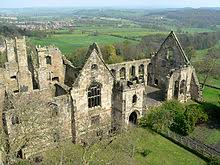
The 7th Earl of Shrewsbury had no sons, only daughters, and so through marriage the manor came into the hands of the Duke of Norfolk. At the start of the Civil War in 1642 he was a supporter of the Parliamentary cause. The manor itself was occupied at first by Parliamentary forces, but after a short siege it was taken by the Royalists who, perhaps because the manor is situated near important north-south and east-west roads, caused some trouble in the local area. Colonel Gell, in charge of the Parliamentary forces of Derbyshire, besieged the manor, but had to march to Marston Moor to help defeat the Royalists there. On their return to Wingfield they quickly restarted the siege and took the manor by bombardment and infantry attack. The commander of the Royalist forces, Colonel Dalby, attempted to get away by disguising himself as an ordinary soldier, but he was recognised by a deserter and shot in the face as he walked out of the gate. There are traces of the trenches and gun emplacements on the hillside outside the manor, the half moon battery by the main gate being the most prominent, but these are mainly overgrown and neglected.
After the war the manor was ordered to be ruined by order of Oliver Cromwell and Parliament – built by one Cromwell, destroyed by another, apparently unrelated Cromwell – so that it could never be used in defence against the state.
At this point we can forget wars and lords as the manor was bought from Norfolk by his steward Immanuel Halton, a keen astronomer and mathematician. He rebuilt part of the manor, basically a house inside what was the great hall. He heavily influenced the young local lad John Flamsteed – from nearby Denby – getting him interested in astronomy, so much so that Flamsteed became the first astronomer royal, helping found the Royal Observatory at Greenwich, London.
A later Halton let the manor fall into ruin when he had Wingfield Hall built across the valley. He even got the builders to make use of the stone from the manor.
The manor is still occupied. In the middle range between the north and south courtyards there is a farmhouse, occupied as such for several hundred years. The south courtyard is the farmyard, and there are various farm buildings dotted around.
The manor itself is in the hands of English Heritage. At the time of writing it is closed for refurbishment. Until last year it was open only the first Saturday of the month during the summer – and then only with a guided tour which omits many of the interesting elements of the story, focusing largely on Mary Queen of Scots rather than war and astronomy.
 Dr Nigel Hunt